Introduction: The Suspension of Meaning
Recently, I often experience a strange sense of disorientation.
When I analyze the profound meanings of classic texts in my articles, or meticulously refine students’ logical reasoning in their papers, a thought crosses my mind: these tasks seem to be performed quite well by large language models, even faster than any of us in terms of knowledge breadth and text coherence. This raises questions not only about the teaching profession but also about the validity of graduate theses.
I had never considered returning to academia after obtaining my PhD, but facing the overall environment, I find myself less brave than I imagined. This anxiety is not just about the environment; I realize I am experiencing what Charles Taylor describes as the “modernity anxiety.” When inherent value coordinates collapse, individuals easily fall into a state of internal confusion. Many life pursuits previously deemed correct—knowledge possession, logical deduction, and maximization of efficiency—seem to lose their foundation in the light of artificial intelligence. If AI is more like a “knowing molecule” than we are, then who are we? Where is our subjectivity? How can we reassert the necessity of human existence in this algorithm-woven world?
This is a crisis for carbon-based civilization. In fact, the pen name “Xiamai” comes from “the wheat fields of summer harvest,” representing the totem of carbon-based civilization in the AI era. Thus, questioning human meaning becomes a philosophical symbol. Professor Cheng Lesong from Peking University’s Philosophy Department states that the essence of the relationship between humans and technology still requires courage directed towards oneself. This crisis of meaning is a delayed “humanistic awakening” after decades of hurried existence. This article attempts to integrate Eastern and Western philosophical resources to explore the possibility of reconstructing subjectivity in the AI era.
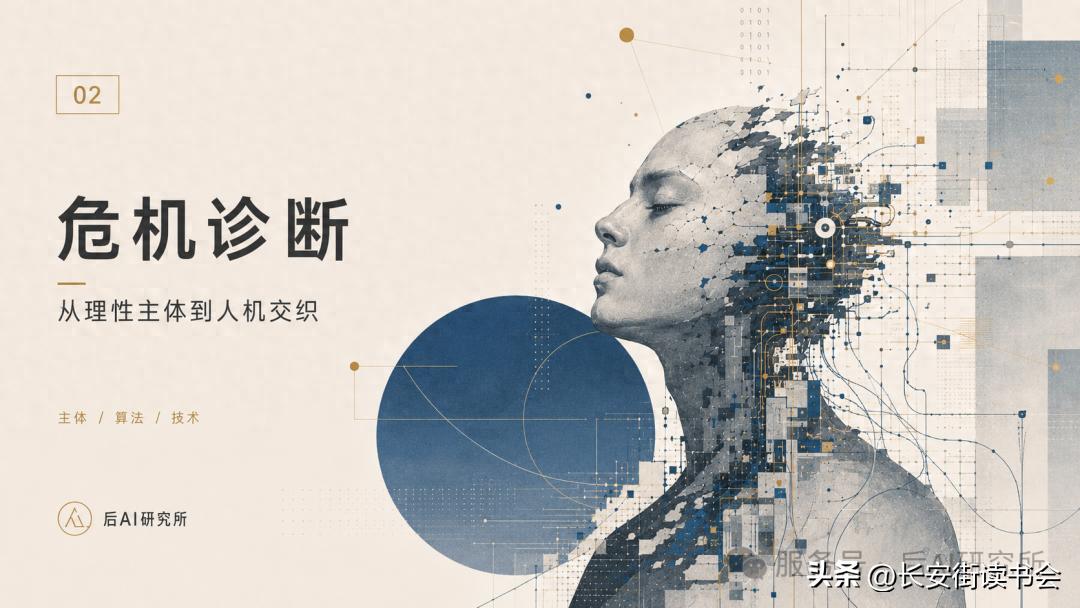
I. Diagnosing the Crisis: From Descartes to Cyborgs
To understand our current predicament, we must return to the origins of Western modern subject philosophy.
Descartes’ proposition “I think, therefore I am” forms a hidden blueprint for modern Western philosophy and law. By establishing the “thinking self” as an unquestionable first entity, Descartes shaped a subject image centered on reason, introspection, and independence. This philosophical conception was later concretized into several key elements: the will is seen as the cornerstone of personality, the subject is presumed to possess autonomous decision-making and accountability, and subject identity requires a self that is continuous in time and essentially unified.
However, the arrival of the cyborg era has shaken this foundation. From implantable medical devices to brain-computer interfaces, from gene editing to AI-assisted decision-making, the human body has become an open field interwoven with organic and inorganic components. Haraway points out that boundary collapse has become a reality. The blurred lines between humans and animals, organisms and machines, physical and non-physical compel us to confront a fundamental question: when human thinking is coupled in real-time with external computational networks via brain-computer interfaces, is the decision derived from autonomous will or a joint output of human-machine systems?
Sartre notes that AI systems are establishing a new “Gestell” regime, a coercive framework that arranges reality according to codes, instructions, and logical rules, leading people to mistakenly believe that algorithms “reveal” hidden truths. This resonates with Heidegger’s concerns about modern technology. For Heidegger, the essence of technology is not a neutral tool but a “Gestell” that reduces all things to calculable “standing reserve.” The human “everyday average state” has already self-dissolved under the rule of the “common people”; AI’s intervention further de-subjectifies this inauthentic state, eliminating the need for the public’s opinion pressure, as the algorithm itself constitutes the norm. In the face of this fate, Heidegger proposed “Gelassenheit” (releasement), not as a compromise between resistance and acceptance, but as maintaining openness to the mystery of existence while utilizing technology, preventing the technological framework from becoming the sole measure of truth. This duality may be the wisdom we need to survive in the face of AI.
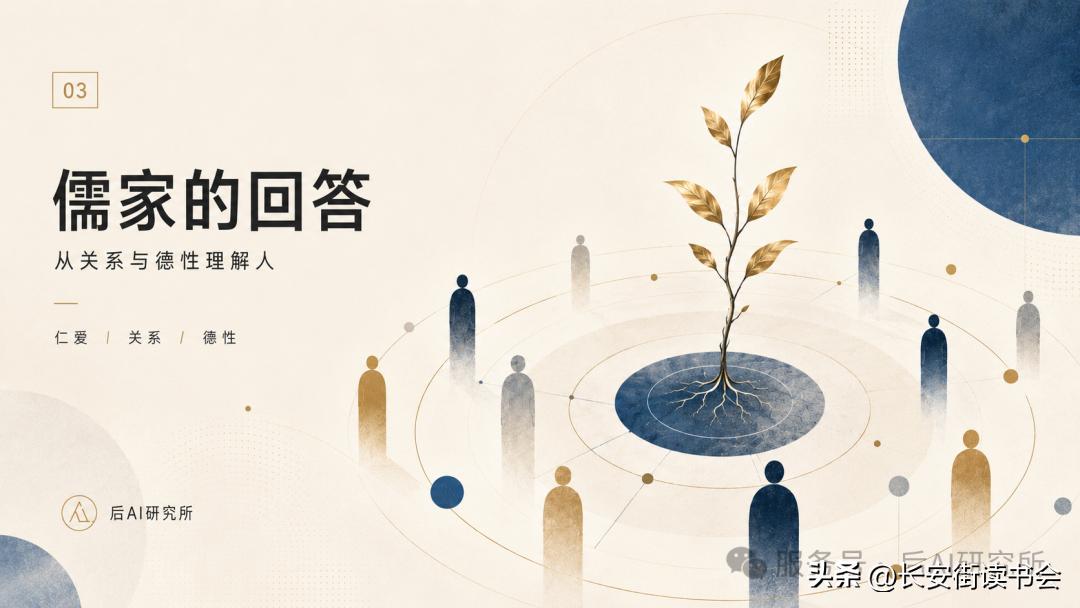
II. Confucian Responses: Generative Life, Affectionate Relations, and the Gentleman as Non-Tool
If the Western philosophical tradition provides a diagnosis of the problem, Eastern Confucian thought offers unique spiritual resources for its resolution.
A. Generative Life: Humanity as the Heart of Heaven and Earth
Confucian understanding of “humanity” is primarily reflected in the core concept of “generative life.” Associate Professor Huang Yanqiang from Wuhan University points out that “generative life” and “affectionate relations” constitute classical Confucian understanding of human existence. “Human beings are the heart of heaven and earth.” In Confucianism, heaven and earth produce all things, and the meaning of generative life manifests as benevolence; humans, created by heaven and earth, derive their nature from the heart of heaven and earth, presenting as “benevolence.”
This sharply contrasts with the Cartesian rational subject. Confucianism does not define humanity from “I think” but from “generative life.” The essence of humanity lies not in abstract rational ability but in participating in the cosmic creation process, in the life awareness that can resonate with all things and unite with heaven and earth. When we question “What is a human” in the AI era, Confucianism answers: humans are beings that can embody the “heart of heaven and earth,” capable of resonating with all things through a heart of benevolence.
B. Affectionate Relations: The Original Field of Ethical Relationships
The second dimension of Confucian understanding of humanity is “affectionate relations.” The Doctrine of the Mean summarizes the virtue standards and ethical norms advocated by Confucius into the “Three Achievements of Virtue” (knowledge, benevolence, courage) and the “Five Relationships” (ruler and subject, father and son, husband and wife, siblings, friends). Mou Zongsan states that the three virtues originate from the three aspects of human spiritual knowledge, emotion, and intention, while the “Five Relationships” are the basic ethical situations that unfold from the three virtues.
Confucianism has always regarded filial piety as the most original moral sentiment. This is not a narrow familialism but an anthropological fact that most human moral consciousness first sprouts in kinship relationships, then extends to others, ultimately reaching the realm of “affectionate relations towards people and love for all things” (Mencius, Book of Heart and Mind).
Of course, in new production and social relationships, kinship among people is no longer as close as in ancient times, nor does it pursue status and hierarchy, which is a natural evolution of the times. However, in the AI era, the significance of this thought lies in the reminder that when virtual relationships increasingly replace real connections, and algorithmic recommendations shape our social circles, Confucian “affectionate relations” remind us: human subjectivity is not formed in isolation but generated in specific relationships. Those most original, corporeal, face-to-face emotional connections are the foundational existence that no algorithm can replicate.
C. The Gentleman as Non-Tool: The Transcendence of Virtue over Instrumentality
Confucius teaches his students that “the gentleman is not a tool” (Analects, Book of Governance). Contemporary scholar Dong Weiguo points out that this should not be simply interpreted as the gentleman being knowledgeable and talented. “Tool” refers to vessels or instruments, extending to specific knowledge and skills. The fundamental difference between humans and tools lies not in humans knowing or doing more but in the fact that human life is a creative existence with specific value goals.
The goal of life is to “become a person” or “become benevolent” (the benevolent one). Pursuing knowledge and skills alone cannot serve as the fundamental grounding of life value. However, our reality often reverses this order; for survival, we must quickly learn knowledge and skills to exchange for fame and fortune, or become immersed in the cleverness of skills, which is an unavoidable phenomenon in contemporary society and a helplessness that mechanizes and instrumentalizes one’s life.
“The gentleman is not a tool” does not deny the value of knowledge and skills. On the level of “tools,” there are significant differences between people, making it difficult to connect. However, at the level of “non-tool,” there must be an existential awareness of this underlying value of being human. We cannot and should not attempt to compete with machines in terms of tool-level efficiency; instead, we should return to the cultivation of virtue as the “body,” reflexively examining those aspects that cannot be replaced by machines, allowing knowledge and skills to serve higher value goals.

III. Daoist Wisdom: Nature, Non-Action, and Releasement
If Confucianism provides a proactive path for constructing subjectivity, Daoism offers another kind of wisdom, one about letting go, about nature, and about wandering in harmony with the Dao.
The core of Daoist thought is “nature.” Here, “nature” is not the “nature” of Western philosophy (as objectified nature) but the state of “being as it is” or “originally so.” Zhuangzi says: “Heaven and earth have great beauty and do not speak; the four seasons have clear laws and do not argue; all things have inherent principles and do not speak” (Zhuangzi, Book of Knowing the North). This understanding of the natural way can correct humanity’s excessive confidence and tendency to try to control everything in the technological age.
Professor Cheng Lesong discusses that after the Industrial Revolution and the Enlightenment, the inception of subject philosophy led to an overconfidence in human rational capabilities. The development of science, particularly the emergence of artificial intelligence, has led people to believe they can ultimately acquire all knowledge and conquer and control the world, even including human consciousness and emotions. This “superior perspective” has, to some extent, transcended the inherent “limitations” of humanity.
Daoism reminds us that humans are not the masters of all things but rather one member among all things. Zhuangzi, in the “Equalizing Things” chapter, dissolves the absolute boundaries of right and wrong, proposing the realm of “heaven and earth are born with me, and all things are one with me.” This does not negate human uniqueness but places it within a larger cosmic perspective. When we no longer cling to the opposition of “human vs. machine,” and no longer worry about the fear of being replaced, we can instead become more at ease in being ourselves.
Daoist “non-action” does not mean doing nothing, but rather “aiding all things in their natural course without daring to act.” In terms of technological design, this means a concept of “treating heaven and earth as one body”; in terms of technology use, it means Heidegger’s “releasement,” using technology while maintaining distance, both accepting and transcending it.

IV. Contemporary Western Philosophy’s Response: From Intersubjectivity to Interfaces
Contemporary Western philosophy is also striving to transcend the limitations of Cartesian subject philosophy, exploring new paradigms for understanding the relationship between humans and technology.
A. The Existentialist Response: The Pursuit of Authenticity
After Heidegger, existentialist thinkers continue to question the human condition in the technological age. Sartre states, “existence precedes essence”; humans first exist, encounter themselves, and emerge in the world, and only then define themselves. In the AI era, this statement gains new meaning: we are not defined by algorithms, nor predicted by data; we shape our existence through our actions at every moment of choice.
Camus writes in “The Myth of Sisyphus,” “One must imagine Sisyphus happy.” Knowing that pushing the stone up the hill is an endless repetition, he still appreciates the beauty of the mountains and seas each time he descends. This may be the attitude we should adopt in facing AI—not to fantasize about ultimate transcendence, but to affirm our existence in every specific choice.
B. The Phenomenological Response: Rebuilding the Life World
Husserl proposed the concept of the “life world” in his later years, reminding us to pay attention: beneath the scientific world lies a more original realm of meaning. It is not a mere accumulation of experiential materials but a foundational understanding woven from subjective intuitive activities and historical traditions, the ultimate source of legitimacy for all scientific propositions. The mathematical wave since Galileo has obscured this foundational world with “idealization,” leading to a crisis of meaning in European science.
Merleau-Ponty extends this to an ontological level, viewing the body as the “medium of existence in the world,” making perception a field where subjectivity and the world intertwine originally. Emotions are no longer mere appendages of consciousness but rather responses of bodily schemata to the world in pre-reflective ways. Schutz shifts the life world from a priori subjectivity to social reality, emphasizing that “emotional fluctuations” and “interpersonal interactions” are the anonymous operations of intersubjectivity.
As artificial intelligence increasingly intervenes in the life world, we must ask: beyond the information pushed by algorithms, are we still in that original realm of meaning? Beyond screen communication, do we still have real emotions and interpersonal connections? Rebuilding the life world is not about rejecting technology but about safeguarding those experiences that cannot be digitized amidst the technological encirclement.
C. The Critical Theory Response: The Disenchantment of Technology
Frankfurt School thinkers have long critiqued technological rationality. Marcuse, in “One-Dimensional Man,” reveals how technology becomes a new form of control, not through violence but by causing people to lose their negativity and transcendence in comfort.
Habermas distinguishes between “instrumental rationality” and “communicative rationality.” Instrumental rationality concerns “how to do,” while communicative rationality concerns “why to do” and “for whom to do.” In the AI era, we need to rebalance these two forms of rationality, preventing instrumental rationality from swallowing communicative rationality and ensuring that efficiency logic does not drown out value inquiries.
D. Contemporary French Philosophy’s Response: Thresholds and Interfaces
Contemporary French philosophy provides unique conceptual tools for understanding the relationship between humans and technology. According to Agamben, the threshold spatializes the state of exception, placing life in a gray area between law and lawlessness. The relationship between humans and intelligent agents is precisely situated in this suspended topology, representing a new configuration of sovereign decision and bare life, resulting in a silent transfer of sovereign decision-making power.
Galloway’s “interface effect” showcases the asymmetric translation between heterogeneous entities in the digital age: the interface, as the materialization of agreements, is not only a translator between media but also a power device that pre-structures action paths. This means that communication in the intelligent age is no longer a Cartesian subject-object relationship but an automated distribution within a network of agreements.
Thus, the interface is not a place of ideals but a site of critical intervention. However, we should not remain stuck in a sense of negative ruin. On one hand, we should excavate and disenchant existing interfaces, revealing how they disguise asymmetric translations as equal communication; on the other hand, we should seek micro-fissures between the layers of agreements, interactions, and bodily perceptions, such as prompt injections, actively increasing subjectivity. Acknowledge that interfaces can never fully translate the incomputable aspects of our bodies (pain, hesitation, unspoken understanding), and also recognize that algorithms have their irreducible operational autonomy. Both exist in the suspended space of thresholds, continuously probing, rubbing, and misaligning, avoiding any party becoming a mere object of the other. This is a form of interactive ethics that does not eliminate asymmetry but offers a constructive method of subjectivity.
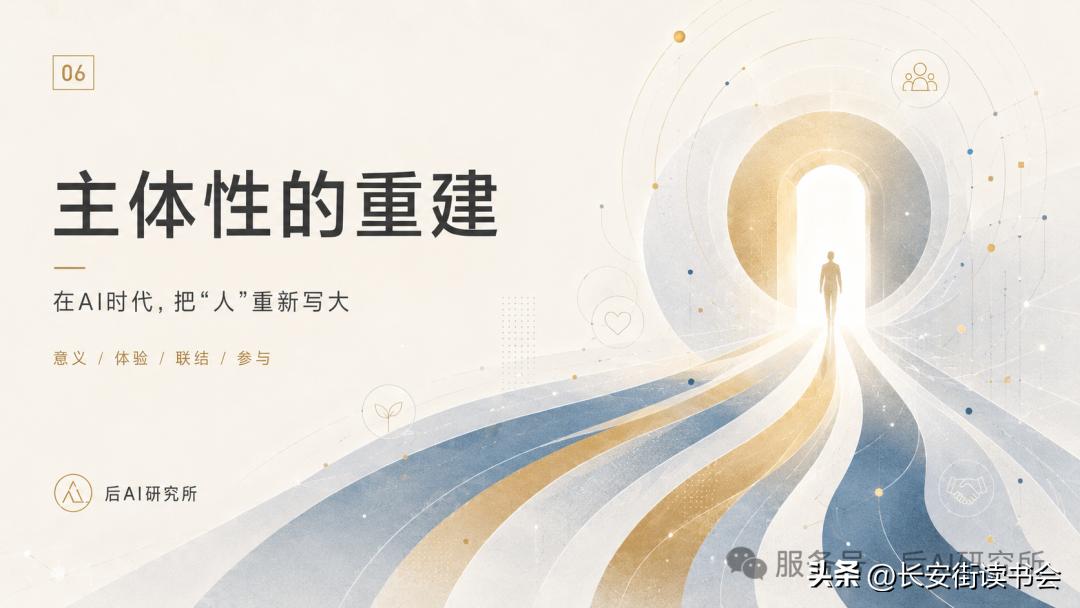
V. Reconstructing Subjectivity: A Fusion of Multiple Paths
Integrating Eastern and Western philosophical resources, we can outline three paths for reconstructing subjectivity in the AI era:
A. From “Container of Knowledge” to “Seeker of Meaning”
Confucian “the gentleman is not a tool” reminds us: humans are not tools, not containers, but seekers of meaning. AI can tell you what Plato’s “Allegory of the Cave” is about, but it cannot experience the shock you feel when reflecting on that allegory at a crossroads in life; AI can analyze the tonal patterns of a regulated poem but cannot explain why, on a lonely night, that line makes you weep.
We need to retrain our perception: no longer satisfied with obtaining answers, but rather questioning those that have no standard answers. What is good? What constitutes a worthy life? In the face of injustice, beyond anger, what else can we do? These questions, because they cannot be quantified by algorithms, become the last bastion of human spirit. When we begin to seek meaning, we are no longer a “knowledge container” waiting to be filled but a “seeker of meaning” emitting a faint yet unique echo in the vast universe.
B. From “Efficiency Tool” to “Integrator of Experience”
Daoist “nature” reminds us: do not be completely engulfed by the logic of efficiency; return to the rhythm of life itself. AI can generate a perfect landscape painting in a second, but it cannot experience the chill felt by the painter in the autumn forest; it can compose the most musically correct piece, but it cannot understand the moment when a musician’s fingers tremble on the keys, recalling a loved one.
Human existence lies precisely in our role as complex “integrators of experience.” We not only live but are aware of our living; we not only endure suffering but can imbue it with meaning; we not only see beauty but can be transformed by it. This corporeal, emotional, intuitive experience is the irreducible redundancy that cannot be digitized, yet it is the core evidence of our existence. In an era dominated by algorithms, being a person who earnestly experiences life is, in itself, an act of rebellion.
C. From “Isolated Individuals” to “Empathetic Connectors”
Confucian “affectionate relations” reminds us: human subjectivity is not formed in isolation but generated in ethical relationships. AI can simulate conversation and even provide companionship in some psychological therapy scenarios, but this “companionship” is fundamentally based on data feedback, lacking genuine “presence.”
In the university setting, what is often most precious is not the lecture notes but the unguarded moments between teachers and students, and among peers: deep discussions in the corridors after class, heated debates arising from differing viewpoints, or even the tacit understanding in silence. In these moments, we are not mere recipients of information but vibrant, warm-blooded beings confirming each other’s existence. Now, many localized communities are emerging, embodying the essence of what it means to be human.
French philosopher Camus said, “Not being loved is just bad luck, but not being able to love is a misfortune.” In the AI era, the ability to “love,” that is, profound empathy, will become exceedingly rare. When we can truly see another’s pain and genuinely rejoice in another’s happiness, we achieve a connection that transcends algorithmic logic. In this connection, we mirror each other, affirming: you exist, therefore I am.
D. From “Algorithmically Assigned User” to “Participating Negotiator”
In the face of AI’s already operational algorithmic thresholds and protocolized interfaces, we are neither omniscient sovereigns nor passive bare lives. The key is to maintain subjectivity in negotiation: neither blindly submitting to technological promises nor retreating to a position of powerless critics, but actively entering the fissures within the interface, creating prompts, questioning output boundaries, participating in open-source communities, and promoting institutional design. Each conscious deviation from default protocols, each demand for algorithms to provide explicable reasons, inscribes new grammar in the current asymmetric translations. The future direction is not solely determined by technology but depends on whether we can persist in our steps amidst the “chaotic dance,” using our physical bodies’ small decisions to continuously disrupt systems that seek to close off possibilities, ensuring that interaction is not merely distribution but a re-distribution.
Conclusion: Blossoming in the Fissures
Returning to the initial question: how can we reclaim subjectivity in the reflection of AI?
Perhaps we do not need to compete with machines in their areas of expertise. But this is not a surrender; rather, it is a liberation that frees us from areas where we are not adept, allowing us to re-examine those traits that truly belong to humanity.
Artificial intelligence acts like a mirror, clearly reflecting our part of “instrumental rationality,” while also revealing the blurred and profound human shadow outside the frame. That shadow carries the weight of our bodies, is filled with historical memories, and is open to the future with hope. As Professor Cheng Lesong states: “The joys and sorrows of humanity are originally interconnected, only expressed in vastly different forms across different eras. What should I love? What should I expect? Who am I? What is my meaning? How should I lead a proper life? These questions are fundamental issues that have always lingered in the minds of people across different eras.”
I believe my phased mission may no longer be to impart knowledge that AI can also answer, but to guide students (and myself): in the fissures of algorithms, bravely love, question, create, and establish genuine connections. This is not an escape but an effort to rewrite the word “human” larger amidst the torrent of technology.
Comments
Discussion is powered by Giscus (GitHub Discussions). Add
repo,repoID,category, andcategoryIDunder[params.comments.giscus]inhugo.tomlusing the values from the Giscus setup tool.