Introduction
AI has become an essential tool for research, content creation, and planning. However, many users find themselves confused when different AI models provide conflicting answers to the same question. This article examines three popular AI models: Doubao, Qianwen, and DeepSeek, analyzing their responses across ten common scenarios to help you determine which model to trust.
Understanding the Core Differences Among the Three AIs
Each AI model has distinct characteristics, stemming from their foundational technologies, training data, and target applications. Here’s a breakdown:
1. Doubao (ByteDance): Versatile and User-Friendly
- Core Positioning: Aimed at everyday users, Doubao excels in casual conversation and daily assistance, focusing on accessibility and emotional engagement.
- Key Features:
- Knowledge Base: Rapid updates, connected to ByteDance’s search engine, covering current trends and policies.
- Hallucination Rate: Low at 4%, with a 96% accuracy rate.
- Strengths: Everyday Q&A, content writing, and natural interactions.
- Weaknesses: Limited in deep logical reasoning and complex coding.
2. Qianwen (Alibaba): Balanced and Reliable
- Core Positioning: Focused on office scenarios and academic support, Qianwen is known for its stability and professionalism.
- Key Features:
- Knowledge Base: Rich in authoritative data, integrating academic and governmental information.
- Hallucination Rate: Moderate, with high accuracy in logic and mathematics.
- Strengths: Document creation, mathematical reasoning, and academic writing.
- Weaknesses: Less natural in casual conversation and slower to update on current events.
3. DeepSeek: Specialized and Technical
- Core Positioning: Targeted at technical development and academic research, DeepSeek is recognized for its depth of knowledge.
- Key Features:
- Knowledge Base: Strong in technical documents and academic papers.
- Hallucination Rate: Moderate, with low errors in specialized fields.
- Strengths: Code programming, logical analysis, and complex problem-solving.
- Weaknesses: Poor in casual interactions and less user-friendly for general audiences.
Comparative Analysis of AI Responses Across Ten Scenarios
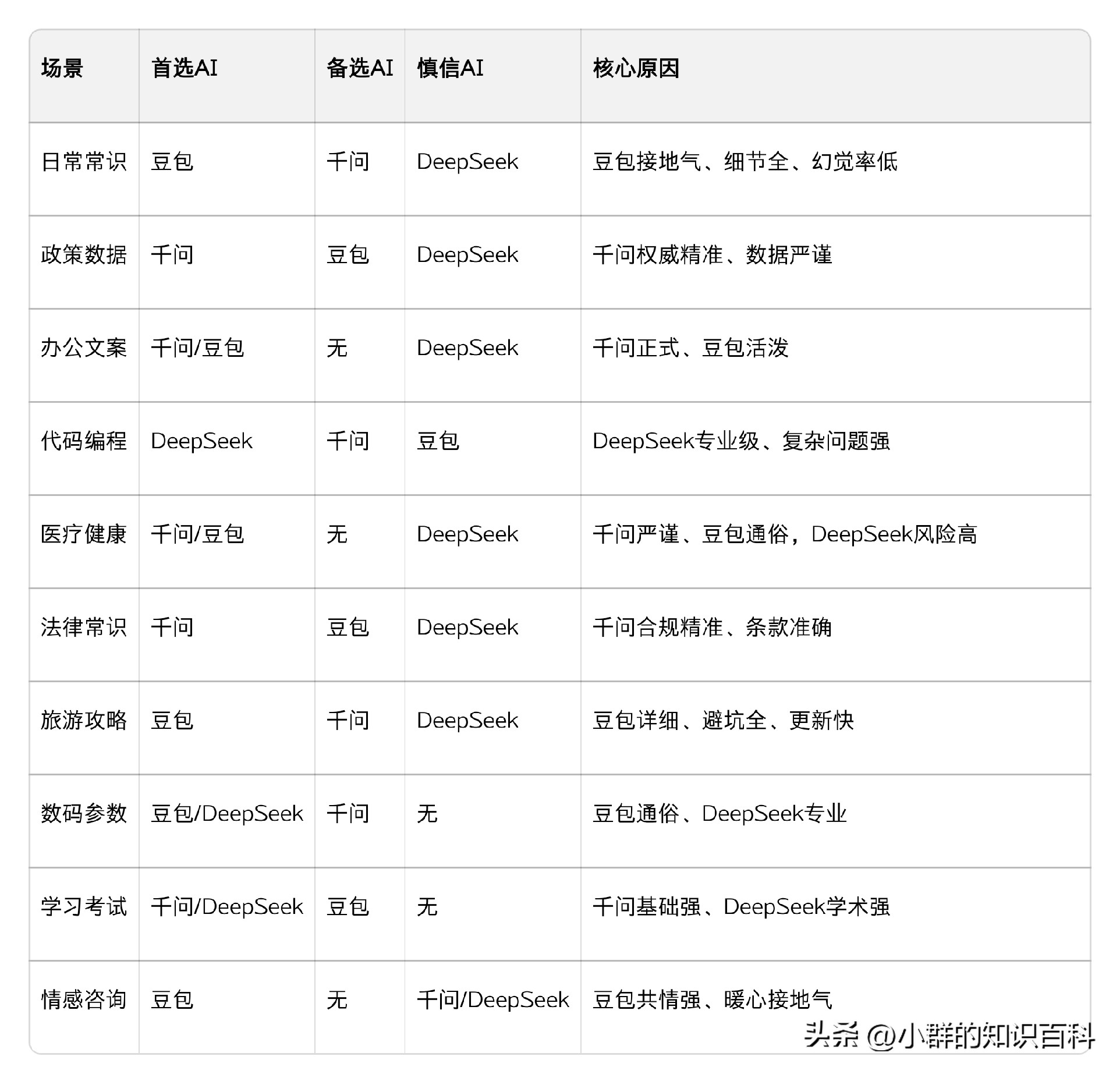
I tested the three AIs across ten common question categories, scoring their responses based on accuracy, consistency, hallucination rate, and practicality. Here are the results:
1. Everyday Knowledge
- Doubao: Accuracy 9.2, Consistency 9.0, Hallucination 3.8%.
- Qianwen: Accuracy 8.5, Consistency 8.8, Hallucination 6.2%.
- DeepSeek: Accuracy 7.8, Consistency 7.5, Hallucination 12.5%.
- Conclusion: Trust Doubao for everyday knowledge, consider Qianwen, and be cautious with DeepSeek.
2. Policy Data
- Doubao: Accuracy 8.8, Consistency 8.5, Hallucination 5.5%.
- Qianwen: Accuracy 9.3, Consistency 9.2, Hallucination 3.2%.
- DeepSeek: Accuracy 8.0, Consistency 7.8, Hallucination 9.8%.
- Conclusion: Trust Qianwen for policy data, with Doubao as a backup, and be cautious with DeepSeek.
3. Office Documents
- Doubao: Accuracy 9.0, Consistency 8.8, Hallucination 4.5%.
- Qianwen: Accuracy 9.4, Consistency 9.3, Hallucination 2.8%.
- DeepSeek: Accuracy 8.2, Consistency 8.0, Hallucination 8.5%.
- Conclusion: Trust Qianwen for formal documents, Doubao for casual writing, and avoid DeepSeek.
4. Code Programming
- Doubao: Accuracy 7.5, Consistency 7.2, Hallucination 15.0%.
- Qianwen: Accuracy 8.8, Consistency 8.5, Hallucination 6.0%.
- DeepSeek: Accuracy 9.5, Consistency 9.4, Hallucination 2.5%.
- Conclusion: Trust DeepSeek for coding, with Qianwen as an alternative, and Doubao for beginners.
5. Medical Health
- Doubao: Accuracy 8.5, Consistency 8.3, Hallucination 6.5%.
- Qianwen: Accuracy 8.8, Consistency 8.7, Hallucination 5.0%.
- DeepSeek: Accuracy 7.2, Consistency 7.0, Hallucination 18.0%.
- Conclusion: Trust Qianwen for medical advice, with Doubao as a reference, and avoid DeepSeek.
6. Legal Knowledge
- Doubao: Accuracy 8.3, Consistency 8.0, Hallucination 7.0%.
- Qianwen: Accuracy 9.0, Consistency 8.8, Hallucination 4.0%.
- DeepSeek: Accuracy 7.8, Consistency 7.5, Hallucination 11.0%.
- Conclusion: Trust Qianwen for legal information, Doubao as a backup, and be cautious with DeepSeek.
7. Travel Guides
- Doubao: Accuracy 9.3, Consistency 9.1, Hallucination 3.5%.
- Qianwen: Accuracy 8.5, Consistency 8.3, Hallucination 6.8%.
- DeepSeek: Accuracy 7.5, Consistency 7.3, Hallucination 14.0%.
- Conclusion: Trust Doubao for travel advice, consider Qianwen, and be cautious with DeepSeek.
8. Digital Parameters
- Doubao: Accuracy 8.8, Consistency 8.6, Hallucination 5.2%.
- Qianwen: Accuracy 8.5, Consistency 8.3, Hallucination 6.5%.
- DeepSeek: Accuracy 9.0, Consistency 8.8, Hallucination 4.0%.
- Conclusion: Trust Doubao for general users and DeepSeek for enthusiasts, with Qianwen as a backup.
9. Learning and Exams
- Doubao: Accuracy 8.5, Consistency 8.3, Hallucination 6.0%.
- Qianwen: Accuracy 9.2, Consistency 9.0, Hallucination 3.5%.
- DeepSeek: Accuracy 8.8, Consistency 8.6, Hallucination 5.5%.
- Conclusion: Trust Qianwen for academic exams, DeepSeek for advanced studies, and Doubao for basic learning.
10. Emotional Counseling
- Doubao: Accuracy 9.4, Consistency 9.2, Hallucination 3.0%.
- Qianwen: Accuracy 8.0, Consistency 7.8, Hallucination 8.0%.
- DeepSeek: Accuracy 6.5, Consistency 6.3, Hallucination 20.0%.
- Conclusion: Trust Doubao for emotional support, avoid Qianwen and DeepSeek.
Core Reasons for Conflicting AI Answers
The discrepancies in answers from the three AIs stem from differences in their foundational mechanisms and data:
- Knowledge Base Update Frequency: Different models have varying update cycles, affecting the freshness of their information.
- Training Data Focus: Each AI has a different emphasis in its training data, leading to strengths and weaknesses in specific areas.
- Model Capabilities: Differences in hallucination rates and reasoning depth can affect the quality of responses.
- Understanding of Questions: Each AI interprets questions from different angles, leading to varied answers.
- Inevitable AI Hallucinations: All AIs are probabilistic models, which can lead to errors in seemingly reasonable responses.
Ultimate Method to Evaluate AI Answers in 2026
To effectively assess AI answers, follow these three steps:
- Identify the Scenario: Choose the AI that excels in the relevant area based on the credibility table.
- Cross-Verify: Ask the same question to all three AIs and compare their answers for consistency.
- Source Verification: For high-risk topics, always consult authoritative sources to confirm the information.
Conclusion
Ultimately, Doubao, Qianwen, and DeepSeek each have their strengths and weaknesses. Choosing the right AI depends on the context:
- Doubao: Best for everyday tasks and casual interactions.
- Qianwen: Ideal for office and academic needs.
- DeepSeek: Suitable for technical and specialized inquiries.
In 2026, remember to match the AI to the task at hand, verify information, and consult authoritative sources for high-risk topics. AI is a tool to enhance efficiency, and understanding its limitations is key.
Comments
Discussion is powered by Giscus (GitHub Discussions). Add
repo,repoID,category, andcategoryIDunder[params.comments.giscus]inhugo.tomlusing the values from the Giscus setup tool.