Understanding the Relationship Between LLM, Agent, Skill, and OpenClaw
Why do some AI systems perform tasks like researching information, writing copy, and organizing files while others only provide basic responses? The key difference lies in the integration of LLM, Agent, Skill, and OpenClaw. This article clarifies these four core concepts in simple terms, ensuring you won’t confuse them again.
1. Core Concepts Explained
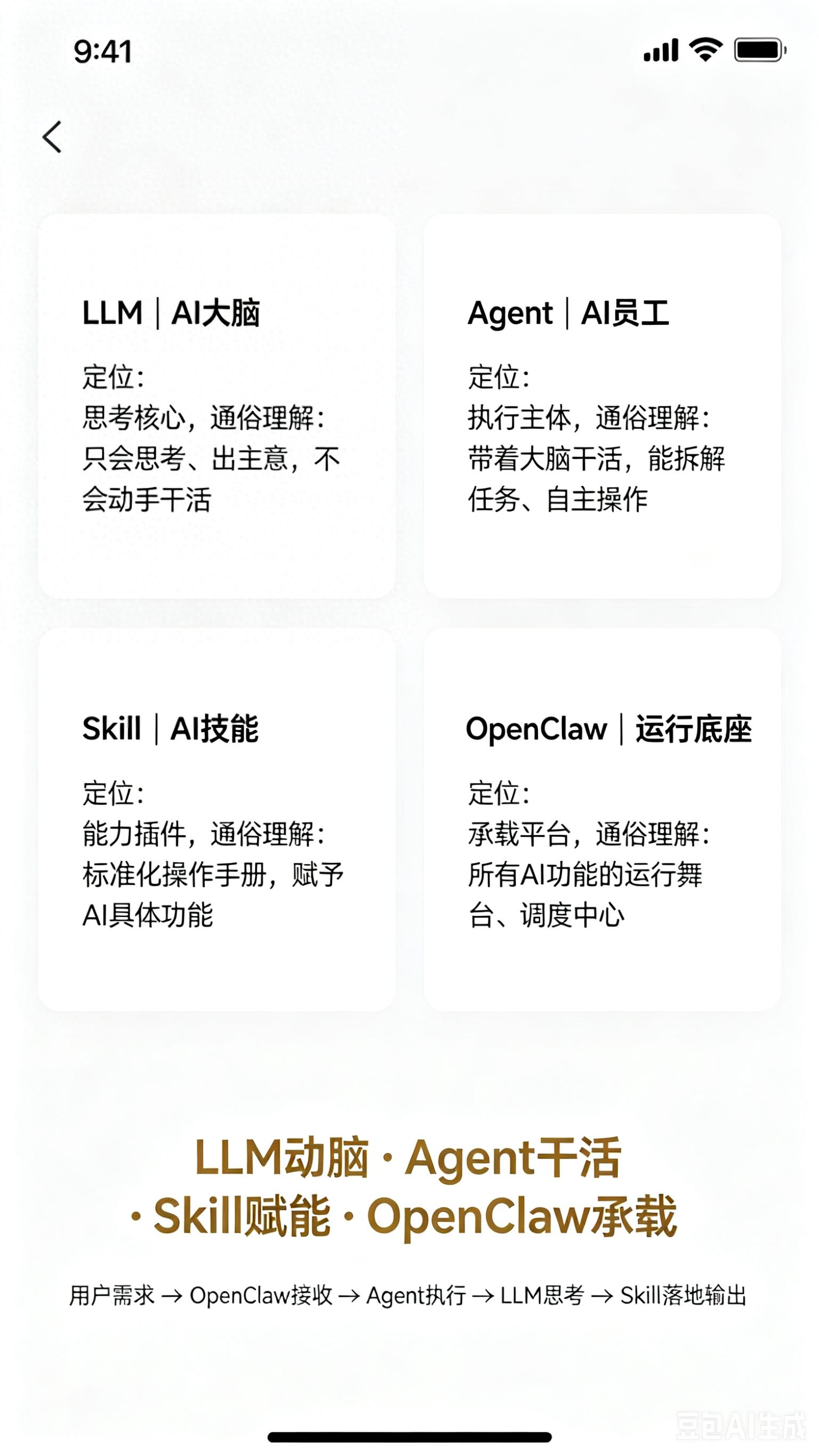
LLM: The “Brain” of AI
LLM (Large Language Model) refers to systems like GPT, Tongyi Qianwen, and Llama, which excel at understanding language, generating text, and logical reasoning.
- Analogy 1: The human “brain” – capable of thinking, generating ideas, and organizing language but unable to take direct action.
- Analogy 2: A company’s “strategic advisor” – responsible for proposing plans and giving advice but not executing them.
- Summary: LLM is the “thinking core” that understands input and generates answers but lacks execution capabilities.
Agent: The “Versatile Employee” of AI
An Agent is an execution unit based on LLM, comprising the LLM (brain), memory, tool-calling capabilities, and task processes. It understands goals, breaks down steps, calls tools, and completes tasks while remembering context.
- Analogy 1: A human “worker” – after understanding the task (LLM), can take action, use tools, and achieve goals step by step.
- Analogy 2: A restaurant “manager” – listens to customer needs (understands commands), organizes kitchen staff (calls tools), follows processes (executes tasks), and remembers customer preferences (memory).
- Summary: The Agent is the “executing entity” that equips the LLM with “hands and memory” to understand commands, break down tasks, and direct actions.
Skill: The “Professional Skills Manual” of AI
Skill is a reusable task rule package for Agents, containing trigger conditions, operational steps, and response scripts, essentially a “standardized function.” Examples include “greeting responses,” “word translation,” and “file organization.”
- Analogy 1: An employee’s “operation manual” – like a “customer service script” or “file organization process,” detailing what to do in various situations.
- Analogy 2: A game “skill book” – learning a skill (Skill) enables a character (Agent) to reliably perform that ability.
- Summary: Skill is a “capability plugin” that equips Agents with specialized skills to complete tasks reliably and consistently in specific scenarios.
OpenClaw: The “Workbench + Management System” of AI
OpenClaw is an open-source, self-hosted AI Agent execution framework/gateway that connects LLM, hosts Agents, manages Skills, and interfaces with chat tools. It does not think (not an LLM) and is not a single Agent but a platform for building and running AI Agents.
- Analogy 1: A company’s “office building + management system” – the building (OpenClaw) houses advisors (LLM) and employees (Agents), who use skill manuals (Skills) to work, with the building providing space, tools, and management rules.
- Analogy 2: A chef’s “kitchen” – the kitchen (OpenClaw) contains recipes (Skills), chefs (Agents), and ideas (LLM), providing the stove, utensils, and processes to enable chefs to cook reliably.
- Summary: OpenClaw is the “base platform” that integrates all components, schedules resources, and provides an operating environment, allowing LLM, Agent, and Skill to work together.
2. Core Relationships: Understanding Dependencies
Hierarchical Relationship (from bottom to top)
OpenClaw (platform base) → Hosts Agent (execution unit) → Integrates LLM (brain core) + Skill (skill plugins)
Collaborative Process (Example Scenario: User asks AI to “write a warm greeting”)
- User Input: Sends a message “Hello, help me write a warm greeting” (to OpenClaw’s chat interface).
- OpenClaw Receives: Forwards the message to the corresponding Agent (employee starts working).
- Agent Calls LLM: Asks LLM (brain) to understand the need: “User wants a warm greeting, triggering the ‘greeting response’ Skill.”
- Agent Loads Skill: Retrieves the “greeting response” skills manual and generates a reply based on the rules.
- Agent Executes + Returns: Sends the result back to the user via OpenClaw, completing the task.
Key Differences (Avoid Confusion!)
- LLM vs Agent: LLM is the “brain”; Agent is the “employee with a brain”; LLM only thinks, while Agent executes.
- Agent vs Skill: Agent is the “employee”; Skill is the “employee’s skills”; one Agent can have multiple Skills (e.g., greeting, translating, organizing files).
- OpenClaw vs Others: OpenClaw is the “platform”; the other three are “components on the platform”; without OpenClaw, Agents and Skills cannot operate reliably or connect with users.
3. Three Golden Analogies (Mastering the Concepts)
Analogy 1: Running an “AI Store”
- LLM = The store manager’s brain: understands customer needs and can generate scripts, but cannot take action.
- Agent = Versatile employee: has the manager’s brain (LLM), can serve customers, use tools, and follow processes.
- Skill = Employee’s service manual: includes scripts like “greeting” and “order processing,” detailing how to perform tasks.
- OpenClaw = Storefront + management system: provides space, customer interface, tool storage, and employee management, enabling the store to operate.
Analogy 2: Playing a “Role-Playing Game”
- LLM = Character’s intelligence: can think, understand the plot, and make decisions.
- Agent = The game character itself: has intelligence (LLM), can move, fight, and use skills.
- Skill = Character’s skill book: learning a skill allows stable usage.
- OpenClaw = Game engine: provides the game world, rules, and interface, allowing characters and skills to function.
Analogy 3: Cooking a “Home-Cooked Meal”
- LLM = Chef’s thoughts: knows what dish to make, the steps, and the flavors needed.
- Agent = The chef: has ideas (LLM), can chop, cook, and use utensils.
- Skill = Recipe: details ingredients, steps, and cooking times.
- OpenClaw = Kitchen: provides the stove, pots, and seasonings, enabling the chef to follow the recipe.
4. Conclusion
Remember the relationships in one sentence: LLM is the brain, Agent is the employee with a brain, Skill is the employee’s skills manual, and OpenClaw is the workbench that supports everything; together, they enable AI to transition from merely “chatting” to becoming an effective executor.
Comments
Discussion is powered by Giscus (GitHub Discussions). Add
repo,repoID,category, andcategoryIDunder[params.comments.giscus]inhugo.tomlusing the values from the Giscus setup tool.